Ditapis dengan

Klimatologi
Daratan mencakup sekiar 30 persen luas permukaan bumi dan dihuni oleh cacing dan hewan sejenisnya, laut mencakup sekitar 70 persen luas permukaan bumi dan dihuni oleh ikan dan hewan sejenisnya, sedangkan luas atmosfer mencakup 100 persen permukaan bumi, yang dihuni oleh manusia, tumbuhan, dan hewan. Manusia dapat bertahan sampai satu hari tanpa air di daerah gurun yang palin panas, tetapi atmos…
- Edisi
- -
- ISBN/ISSN
- 979-3507-05-5
- Deskripsi Fisik
- 14a; 348 hlm; 21cm
- Judul Seri
- -
- No. Panggil
- PVG 551.58 Tja k c.1
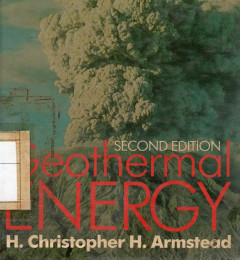
Geothermal Energy
Within a few years earth heat-or to use its more scientific but ponderous title, geothermal energy-may well become a factor of supreme importance for the survival of industrial man. Its resources are gigantic, could we but again easier access to them, and it is vitally necessary that the gospel of its study and exploitation be propagated as widely and as rapidly as possible. Hence this book. It…
- Edisi
- -
- ISBN/ISSN
- 0-419-12220-6
- Deskripsi Fisik
- xxxviii; 389 hlm; tabel
- Judul Seri
- -
- No. Panggil
- PVG 551.23 Arm g c.1

Geothermal Systems: Principles and Case Histories
Geothermal systems can be defined and classified on the basis of thei geological, hydrological, and heat transfer characteristics. The term"geothermal" refers to the internal thermal energy of the Earth; in general it is employed to denote systems in which the Earth's heat sufficiently concentrated to form and energy resource. Since the thermal energy of the Earth's crust is stored predominantl…
- Edisi
- -
- ISBN/ISSN
- 0-471-27811- 4
- Deskripsi Fisik
- 337 hlm.; gbr.
- Judul Seri
- -
- No. Panggil
- PVG 551.23 RYB G C.1
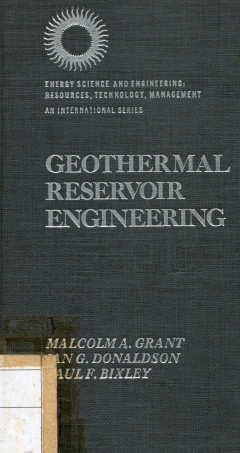
Geothermal Reservoir Engineering
Prior to this century geothermal energy (the earth's heat) was not used to any great extent. In populous and affluent areas, such as Europe, surface manifestations of this resource were limited in both extent and intensity, and the warm spring waters were used in spas and bathing facilities rather than as sources of energy. In the more remote areas where more intensive activity occurred, the lo…
- Edisi
- -
- ISBN/ISSN
- 0-12-295620-6
- Deskripsi Fisik
- xiii; 359 hlm
- Judul Seri
- -
- No. Panggil
- PVG 551.23 GRA g c.1
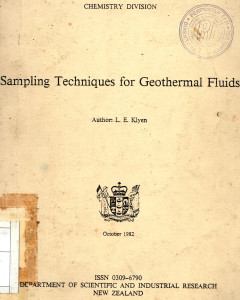
Sampling Techniques for Geothermal Fluids
This manual gives instructions for the collection of water and gas samples from geothermal wells, Springs and fumaroles. It aims to provide a ready reference for those new to geothermal field work. For this reason emphasis is laid upon practical aspects of the various yehniques and itmes of equipment rather than upon theoritical principles. The techniques and devices described are those develop…
- Edisi
- -
- ISBN/ISSN
- 0309-6790
- Deskripsi Fisik
- 88 hlm
- Judul Seri
- -
- No. Panggil
- PVG 551.23 Kly s c.1
Geothermal Energy as a Source of Electric Power: Thermodynamic and Economic D…
Optimum utilization of a geothermal energy resource, in both an economic and thermodynamic sense, is strongly dependent on the characteristic of the geothermal fluid. In particular, temperature, pressure, composition, and liquid to vapor ratio are important in determining the best method and conditions for energy conversion. Because the tempratures of most geothermal fluids are low, producing e…
- Edisi
- -
- ISBN/ISSN
- 0-262-13123-4
- Deskripsi Fisik
- 183 hal,; gbr.; lamp.; tabel.
- Judul Seri
- -
- No. Panggil
- PVG 551.23 MIL g C.1
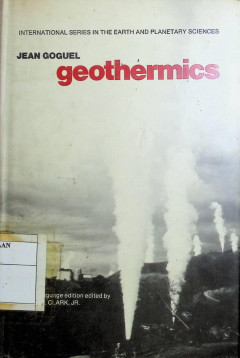
Geothermics
Geothermics can be defined as the study of the temperature distribution in the earth and the phenomena which in fluence that distribution. At the earth's surface and in the atmosphere, complex meteorological events occur which are strongly influenced by temperature. These phenomena will only be mentioned briefly. Large areas of geology are frequently discussed without alluding to the temperatur…
- Edisi
- -
- ISBN/ISSN
- 0-07-023518-X
- Deskripsi Fisik
- 195 hal,; gbr.; lamp.; tabel; foto; peta
- Judul Seri
- -
- No. Panggil
- PVG 551.23 GOG g C.1

Geothermal Resources: An Energy Alternative
The monograph Geothermal Resources: An Energy Alternative by Harsh K. Gupta presents for the first time a readable, coherent account of all facets of geothermal energy development. The development of alternative, renewable energy resources during the past decade has been spurred by a crunch in the supplies of traditional hydrocarbon energy resources, which have previously been inexpensive and r…
- Edisi
- -
- ISBN/ISSN
- 0-444-41865-2
- Deskripsi Fisik
- 215 hlm.;gbr.
- Judul Seri
- -
- No. Panggil
- PVG 551.23 Gup g C.1
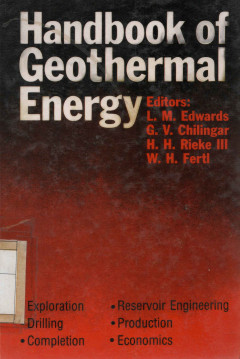
Handbook of Geothermal Energy
Although not widely understood, geothermal energy is an old concept that has assumed new importance. In the broadest sense it is the natural heat of the earth. Leibowitz (1978) defined geothermal energy as the natural heat in the earth that is trapped close enough to the surface to be extracted economically. Unfortunately, in most intances, geothermal energy is too dispersed in the outer crust …
- Edisi
- -
- ISBN/ISSN
- 0-87201-322-7
- Deskripsi Fisik
- ix; 589 hlm
- Judul Seri
- -
- No. Panggil
- PVG 551.23 Edw h c.1

Chemistry and Geothermal Systems
The term geothermal energy is used in this book in a resticted way, to refer to the potentially useful energy stored as hot water or steam in favorable geological situations within the top few kilometers of the earth's crust. It is contained in a geothermal area or geothermal field with finite surface boundaries and in a particular rock-hydrological situation (geothermal system). The specialize…
- Edisi
- -
- ISBN/ISSN
- 0-12-237450-9
- Deskripsi Fisik
- 379 hlm.; gbr.
- Judul Seri
- -
- No. Panggil
- PVG 551.23 ELL c C.1
 Karya Umum
 Filsafat
 Agama
 Ilmu-ilmu Sosial
 Bahasa
 Ilmu-ilmu Murni
 Ilmu-ilmu Terapan
 Kesenian, Hiburan, dan Olahraga
 Kesusastraan
 Geografi dan Sejarah