Ditapis dengan
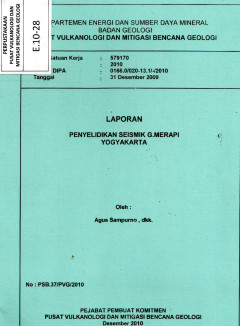
Laporan Penyelidikan Seismik G. Merapi Yogyakarta
Sejak Awal September 2010, Aktivitas Seismik G. Merapi meningkat tajam hingga status aktivitas dinaikkan menjadi "Waspada" pada 20 september 2010. Untuk itu perlu dilakukan penguatan sisten monitoring seismik untuk menjamin ketersediaan data yang real-time dan akurat. Penyediaan informasi secara real time yang dapat menginterpetasikan energi seismik secara cepat harus dilakukan.
- Edisi
- -
- ISBN/ISSN
- -
- Deskripsi Fisik
- 18 hlm;gambar;tabel
- Judul Seri
- -
- No. Panggil
- PVG E.10-28

Laporan Penyelidikan Tanggap Darurat Letusan G. Merapi, Yogyakarta
Letusan gunung Merapi tahun 2010 merupakan letusan yang cukup dahsyat di banding dengan letusan 10 tahun terakhir ini. Aktifitas vulkanik tahun 2010 kalau dibandingkan dengan letusan tahun 2006, terjadi peningkatan gempa yang cukup signifikan. Peningkatan intensitas gempa vulkanik dapat dirasakan di semua pos Pengamatan G. Merapi.
- Edisi
- -
- ISBN/ISSN
- -
- Deskripsi Fisik
- 14 hlm;foto;tabel;peta
- Judul Seri
- -
- No. Panggil
- PVG E.10-27
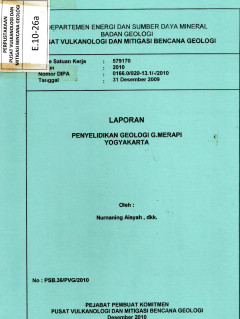
Laporan Penyelidikan Geologi G. Merapi Yogyakarta
Erupsi suatu gunungapi telah menarik perhatian masyarakat umum sekitar 2 tahun terakhir ini, seperti halnya bencana geologi lain yaitu gempabumi, tanah longsor, dan tsunami. Indonesia merupakan Negara yang memiliki gunungapi aktif cukup banyak yaitu sekitar 129 gunungapi yang berderet sepanjang pula Sumatra-Jawa-NTB_NTT_Sulawesi.
- Edisi
- -
- ISBN/ISSN
- -
- Deskripsi Fisik
- 13 hlm;tabel;gambar
- Judul Seri
- -
- No. Panggil
- PVG E.10-26
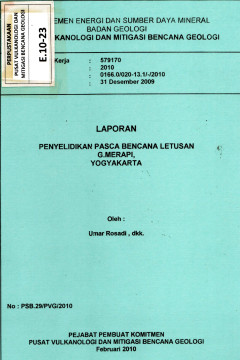
Laporan Penyelidikan Pasca bencana Letusan G. Merapi, Yogyakarta
Gunung Merapi merupakan gunungapi tipe strato, dengan ketinggian 2980 meter dari permukaan laut (sebelum erupsi 2010). Secara administratif terletak pada 4 wilayah kabupaten yaitu Kabupaten Sleman, Kabupaten Magelang, Kabupaten Boyolali, dan Kabupaten Klaten. Status aktivitas G. Merapi ditingkatkan dari Normal menjadi Waspada pada tanggal 20 September 2010.
- Edisi
- -
- ISBN/ISSN
- -
- Deskripsi Fisik
- 42 hlm;gambar;tabel
- Judul Seri
- -
- No. Panggil
- PVG E.10-23

The Behavior of Fluorine, Chlorine and Sulfur in The Magma of Merapi Volcano,…
Merapi volcano, located at Central Java - Indoensia, is one of the world's mpst active volcano. In order to gain better understanding on volcanism and magmatism of this calc-alkaline volcano, various research have been carried out. Some valuable information concering volcanism of Merapi volcano can be indirectly obtaine through the investigation of fluorine, chlorine and sulfur behavior in the …
- Edisi
- -
- ISBN/ISSN
- -
- Deskripsi Fisik
- 11 hlm;gambar
- Judul Seri
- -
- No. Panggil
- PVG E.08-35

Laporan Pemetaan Potensi Lahar K. Gendol, K. Woro dan K. Kuning Di Lereng Sel…
K. Gendol merupakan alur sungai yang paling dominan terisi oleh material letusan G. Merapi 14 Juni 2006, disamping K. Opak, K. Woro, K. Kuning, K. Boyong, K. Bedog dan K. Krasak. Seluruh material yang masuk ke sungai-sungai tersebut diperkirakan sejumlah 8-9 jutaan m3. Sepertiga material tersebut sudah tertranspot menjadi lahar pada masing-masing alur sungai pada musim penghujan 2006-2007.
- Edisi
- -
- ISBN/ISSN
- -
- Deskripsi Fisik
- 27 hlm;foto;gambar
- Judul Seri
- -
- No. Panggil
- PVG E.07-36
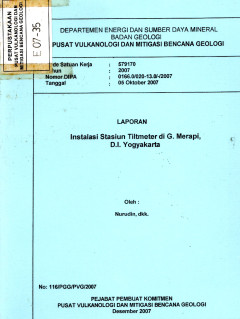
Laporan Instalasi Stasiun Tiltmeter Di G. Merapi, D.I. Yogyakarta
Pemantauan Gunungapi menjadi kegiatan yang wajib dilakukan, mengingat di wilayah Indonesia terdapat kurang lebih 130 gunungapi aktif yang sewaktu-waktu berpotensi terjadinya letusan dan mengancam kehidupan di sekitarnya. Gunung Merapi adalah salah satu diantaranya, gunung ini dikenal dengan tipe letusannya yang khas, yaitu berupa leleran awan panas.
- Edisi
- -
- ISBN/ISSN
- -
- Deskripsi Fisik
- 14 hlm;gambar
- Judul Seri
- -
- No. Panggil
- PVG E.07-35
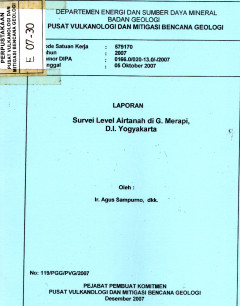
Laporan Survei Level Air Tanah Di G. Merapi, D.I. Yogyakarta
Airtanah merupakan salah satu sumber air bersih yang dimanfaatkan oleh manusia dalam memenuhi kebutuhan air untuk kelangsungan hidupnya. Aktivitas manusia pada dasarnya dapat memberikan dampak positif maupun negatif terhadap kondisi air pada suatu daerah. Kegiatan-kegiatan yang berupa perubahan tata guna lahan dari lahan persawahan/hutan menjadi lahan hunian/perumahan maupun kegiatan penambangan.
- Edisi
- -
- ISBN/ISSN
- -
- Deskripsi Fisik
- 36 hlm;gambar
- Judul Seri
- -
- No. Panggil
- PVG E.07-30
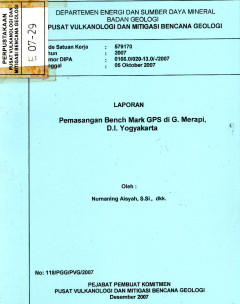
Laporan Pemasangan Bench Mark GPS Di G. Merapi D.I. Yogyakarta
Indonesia dipengaruhi oleh dua lingkaran pegunungan, yaitu lingkaran Sirkum Pasifik dan lingkaran Sirkum Mediterania, serta dipengaruhi oleh lempeng lithosfer, yaitu Lempeng Asia, Lempeng Pasifik dan Lempeng Indo-Australia. Lempeng yang tersubduksi akan mencair karena ada dalam lapisan selubung bumi yang panas maka lempeng yang cair akan membentuk magma.
- Edisi
- -
- ISBN/ISSN
- -
- Deskripsi Fisik
- 27 hlm;gmbr
- Judul Seri
- -
- No. Panggil
- PVG E.07-29

Laporan Tanggap Darurat Letusan G. Merapi, Jawa Tengah D.I. Yogyakarta
Gunung Merapi merupakan gunungapi tipe andesit-basaltik terletak di perbatasan antara Jawa Tengah dan Daerah Istimewa Yogyakarta. Puncak Merapi mempunyai ketinggian sekitar 2986 m d.p.l. (data GPS - 1999, posisi lava 40). Aktivitas yang hampir terus menerus terjadi menyebabkan kawah, dan puncak merapi mengalami perkembangan dari waktu ke waktu.
- Edisi
- -
- ISBN/ISSN
- -
- Deskripsi Fisik
- 16 hlm;gambar;foto
- Judul Seri
- -
- No. Panggil
- PVG E.06-40
 Karya Umum
  Filsafat
  Agama
Agama  Ilmu-ilmu Sosial
  Bahasa
  Ilmu-ilmu Murni
  Ilmu-ilmu Terapan
  Kesenian, Hiburan, dan Olahraga
  Kesusastraan
  Geografi dan Sejarah