Ditapis dengan
The Principles of Petrology
The Science of Petrology-Petrology is the science of rocks, that is, of the more or less definite units of which the earth is built. In the nature of things the study is limited to the materials of the accessible crust, although we have in meteorites samples of rocks which must be identical with, or analogous ti, those composing the interior of the earth. The science deals with the modes of occ…
- Edisi
- -
- ISBN/ISSN
- -
- Deskripsi Fisik
- xii; 335 hlm
- Judul Seri
- -
- No. Panggil
- PVG 552 Tyr p c.1
Principles of Sedimentology
Sedimentology, a term proposed in 1932 by H. A. Wadell, is most simply defined as the scientific study of sediments. The term sediment refers to regolith that has been transported. Sediment is a word derived from the Latin sedimentum, which means" a settling." Not stated, but implied in the minds of many users of the term, is the idea that the settling occurred through air or water. As used by …
- Edisi
- -
- ISBN/ISSN
- 0-471-06151-4
- Deskripsi Fisik
- xiii; 769 hlm
- Judul Seri
- -
- No. Panggil
- PVG 552.5 Fri p c.1

Origin of Sedimentary Rocks
The three main classes of rocks, igneous, sedimentary, and metamorphic, were first clearly distinguished in the mid-nineteenth century. At first, the origin of sedimentary rocks was much better understood than that of the other two classes. Thus geologists turned their attention to such rocks as basalt, granite, and schists, whose origin was more controversial. For years, the only questions ask…
- Edisi
- -
- ISBN/ISSN
- 0-13-642702-2
- Deskripsi Fisik
- xix; 609 hlm
- Judul Seri
- -
- No. Panggil
- PVG 552.5 Bla o c.1
The Evolution of the Igneous Rocks
The science of igneous petrogenesis is a study of the origin and evolution of rocks that have formed through the generation of magmas by melting processes, and the cooling of those magmas from a liquid, or liquid and crystalline state, into a glassy to crystalline state. Field and textural observations do not constitute sufficient evidence for defining a rock as igneous in origin but when allie…
- Edisi
- -
- ISBN/ISSN
- -
- Deskripsi Fisik
- ix; 586 hlm
- Judul Seri
- -
- No. Panggil
- PVG 552.3 Yod e c.1
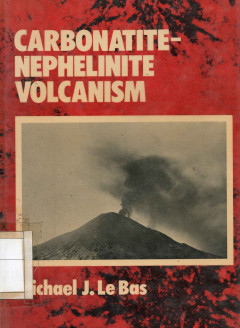
Carbonatite- Nephelinte Volcanism
The classic igneous intrusions of Fen are typical examples of carbonatite-ijolite magmatic igneous complexes, but they do not have preserved for inspection the full range of volcanic and subvolcanic rocks. Likewise, the famous Calesdonian mafic alkaline igneous complexes of the Kota Peninsula in northwestern USSR are deficient in the extrusive facies. These deficiencies merely reflect the chang…
- Edisi
- -
- ISBN/ISSN
- 0-471-99422-7
- Deskripsi Fisik
- 347 hlm
- Judul Seri
- -
- No. Panggil
- PVG 552.2 Leb c c.1
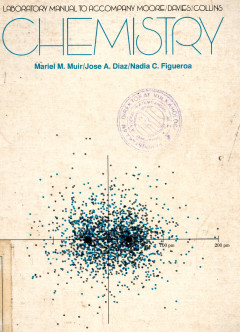
Chemistry
Most accidents in a chemical laboratory are the result of carelessness or poor judgment either by the injured person or by a neighbor. Every individual who works in the laboratory must learn and observe the safety rules listed here. In addition you should develop the habit of thingking beforehand about the possible risk in any experimental procedure. Many experiments in this manual hav safety n…
- Edisi
- -
- ISBN/ISSN
- 0-07-042928-6
- Deskripsi Fisik
- ix; 333 hlm
- Judul Seri
- -
- No. Panggil
- PVG 552.2 Mui c c.1
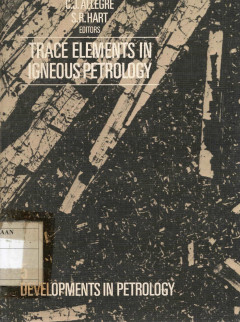
Trace Elements in Igneous Petrology
It was the deep-seated conviction of Paul Gast that the trace element approach was at least as powerful as expertimental petrology to solve the major petrological problems. In this paper, we review the present status of the utilization of trace elements in igneous processes, which acknowledges his opinion. After a study of the historical development of trace element geochemistry which indludes …
- Edisi
- -
- ISBN/ISSN
- 0-444-41658-7
- Deskripsi Fisik
- xi; 270 hlm
- Judul Seri
- -
- No. Panggil
- PVG 552 All t c.1

G. Gamalama di Pulau Ternate dan Keadaannya dalam Th. 1969
Selama pelawatan penulis ke Ternate dalam permulaan tahun 1969, maka selain telah dilakukannja penidjauan terhadap G. Kie Besi di pulau Makian, G. Gamkonora di Halmaheira dan G. Gamalama telah sempat pula dikundjungi. Adapun pemeriksaan terhadap puncaknya dilakukan oleh rekannya Sdr. S. Hamidi, sedang penulis mengikutiya juga, terutama sebagai juru potret. Dalam karangan ini penulis tambahkan …
- Edisi
- -
- ISBN/ISSN
- -
- Deskripsi Fisik
- 39 hml.; gmbr.; peta
- Judul Seri
- -
- No. Panggil
- PVG K.69-10

Laporan Pemetaan Geologi Gunungapi Kie Besi (Makian), Kab. Maluku Utara, Prov…
Gunungapi Kie Besi (Makian) atau dengan nama lain Wakiong termasuk gunungapi aktif bertipe A, yang berbentuk strato dan merupakan sebuah pulau gunungapi Bentuk strato ini adalah karakteristik dari bentuk-bentuk gunungapi yang ditemukan pada zona "subducting plate margin Berdasarkan acuan dari teratur dan aktifitasnya, tercatat sejak tahun 1550 sampai dengan tahun 1988, terjadi kegiatan erupsi s…
- Edisi
- -
- ISBN/ISSN
- -
- Deskripsi Fisik
- 59 hml.; gmbr.; peta
- Judul Seri
- -
- No. Panggil
- PVG K.99-4

Laporan Pemetaan Geologi G. Api Gamkonora dan Sekitarnya Kab. Maluku Utara (H…
Daerah pemetaan secara administratif, termasuk ke dalam Wilayah Kecamatan Ibu, Kewedanaan Jailolo, Kabupaten Maluku Utara, Propinsi Maluku. Letak geografisnya, berada pada koordinat (1°16'42,5"-1°29′33,6") LU, dan (127'35'17"-127°54'18"BT). Sedangkan posisi G. Gamkonoranya sendiri, terletak pada koordinat 01°22'30" LU dan 127°34'BT dengan ketinggian sekitar 1635 m dpl (Gb. 1). G. G…
- Edisi
- -
- ISBN/ISSN
- -
- Deskripsi Fisik
- 111 hml.; gmbr.; peta
- Judul Seri
- -
- No. Panggil
- PVG K.95-4
 Karya Umum
 Filsafat
 Agama
 Ilmu-ilmu Sosial
 Bahasa
 Ilmu-ilmu Murni
 Ilmu-ilmu Terapan
 Kesenian, Hiburan, dan Olahraga
 Kesusastraan
 Geografi dan Sejarah